

Celebrating 15 Years of Life Floor Through the Story of Its Co-Founder and CEO

2012 Minnesota Cup, Entrepreneurial Competition, where Life Floor won the General Business Division.
This August, Life Floor celebrates 15 years of helping create safer, more beautiful aquatic environments around the world. Over those 15 years, the company has grown from an idea into a global presence, but behind that growth is a story shaped by much more than product development, projects, or business milestones. It is a story of discipline, faith, mentorship, risk, and a belief that meaningful change rarely happens overnight.
For this special anniversary edition of Splash Into Your Story, we sat down with Life Floor Co-Founder and CEO Jonathan Keller to talk less about the company itself and more about the person behind it. From the stories that inspired him as a child to the mentors who challenged his thinking, the moment Life Floor's purpose became clear, and the people who continue to make the aquatics industry meaningful to him, Jonathan reflects on the experiences that helped shape both his leadership and Life Floor's mission.
Meet Jonathan Keller, Co-Founder and CEO of Life Floor
What's a story that inspired you as a kid?
I read a lot of biographies growing up, especially sports biographies. Kirby Puckett's story really stood out to me. He grew up in the projects in Chicago and went on to become such an important player on two Minnesota Twins World Series teams. I remember being inspired by the work and dedication it took for him to get there. It reinforced something that has stayed with me throughout my life: talent matters, but discipline, practice, and consistency are what really make people better.
I grew up during Michael Jordan's prime, so I read a lot about him as well. Then, when I got into high school and became more interested in running, Running With the Buffaloes became another story that inspired me. The book follows the University of Colorado men's cross-country team through an entire season, including their daily training, injuries, setbacks, and pursuit of a national championship. I loved the idea that you could set a meaningful goal, create a plan, work that plan every day, and eventually accomplish something significant.
Biblical stories were also important to me as a kid. I took a while to grow, so I remember identifying with Zacchaeus because he was small but was still noticed and chosen by Jesus. I also connected with David being the youngest of his brothers and still being chosen to become king. Those stories gave me a sense that being overlooked, underestimated, or not fitting the obvious mold didn't mean you couldn't have an important role to play.
Discipline, Faith, and the Pursuit of Potential
What motivates you every day?
I realized relatively early that I had a decent amount of talent in school, sports, and building relationships with people, but talent only gets you so far. One of the things I've always been good at is discipline: training, working toward something, and being willing to consistently do the same things over and over again when they are moving me toward a goal.
A lot of that motivation comes from believing that I have God-given gifts and potential and that I'm responsible for being a good steward of them. I think often about the parable of the talents and the idea that we're given different gifts, but we're also expected to do something meaningful with them. For me, that applies not only to pursuing my own potential, but also Life Floor's potential and the potential of the people around me. Helping other people grow into what they're capable of becoming is a big part of what motivates me.

Keller Family aboard Wonder of the Seas - February 2026
My family is another major part of that. I have four kids who are dependent on me, and I want to see them grow into who God created them to be. That means I also need to model, as well as I can, what it looks like to work hard, pursue excellence, and use the gifts you've been given responsibly.

Jonathan and his oldest son, Jack
I'm also energized by watching people perform at the top of their craft. I love live experiences: sporting events, concerts, shows, because there is something powerful about experiencing excellence alongside other people. Whether it is athletics, music, acting, or another pursuit, I enjoy watching people fully commit to becoming great at something. That pursuit of excellence has always been interesting and motivating to me.
The Inspiration Behind Life Floor
Was there a moment when you realized what Life Floor was really about?
There was a very specific moment. In July 2011, Pat Simmons sat me down and basically asked, "What the heck are you doing? Why are you leaving this proven, successful route to go start a company?"
At the time, we were trying to figure out what to call the product, and I was talking about the technology, how cool I thought it was, and how big I believed the market could become. Pat kept pushing back and asking hard questions. He essentially acted like he didn't understand why any of that mattered, and I remember getting frustrated with him.
Eventually, I got mad enough that I just said it: "Because I think we'll save people's lives."
That was the moment when all of the other noise fell away. People fall and get hurt in aquatic environments. Someone can slip, hit their head, sustain a concussion, fall into an unattended pool, or suffer another serious injury. I believed then, and still believe now, that if we could make those environments safer, we could prevent injuries and potentially save lives.
That conversation forced me to articulate something I hadn't fully put into words yet. It wasn't really about the technology or how large the market might become. It was about why the product needed to exist in the first place. That sense of purpose became foundational to Life Floor and continues to guide the way I think about what we do.
Starting Life Floor at 24: Purpose Before Entrepreneurship
What advice would you give someone who wants to start their own company?
Don't do it.
I say that partly to get people's attention, but also because I think anyone considering entrepreneurship needs to understand the cost. Starting a company is often portrayed as exciting or glamorous, and people tend to notice the big success stories. The reality is that for most entrepreneurs, it is extremely difficult and requires far more sacrifice, uncertainty, and grit than people expect.

Jonathan Keller and Spencer Howell testing if a cell phone could be dropped on Life Floor without breaking, 2011.
If you don't have the temperament to go to bed on a Friday not knowing whether there will be enough cash in the bank on Monday to make payroll, this may not be the life for you. Those kinds of moments happen. Even successful businesses face situations that test you financially, emotionally, and personally.
When someone tells me they want to start a company, I want to understand their why. What problem are they trying to solve? Why do they care about it? Do they have both the aptitude and the passion to keep going when things get difficult? Do they have people around them who will support them? If I tell someone not to do it and they immediately accept that answer, it may tell me something. If they push back and explain why they care so deeply that they feel they have to pursue it anyway, then I become much more interested.
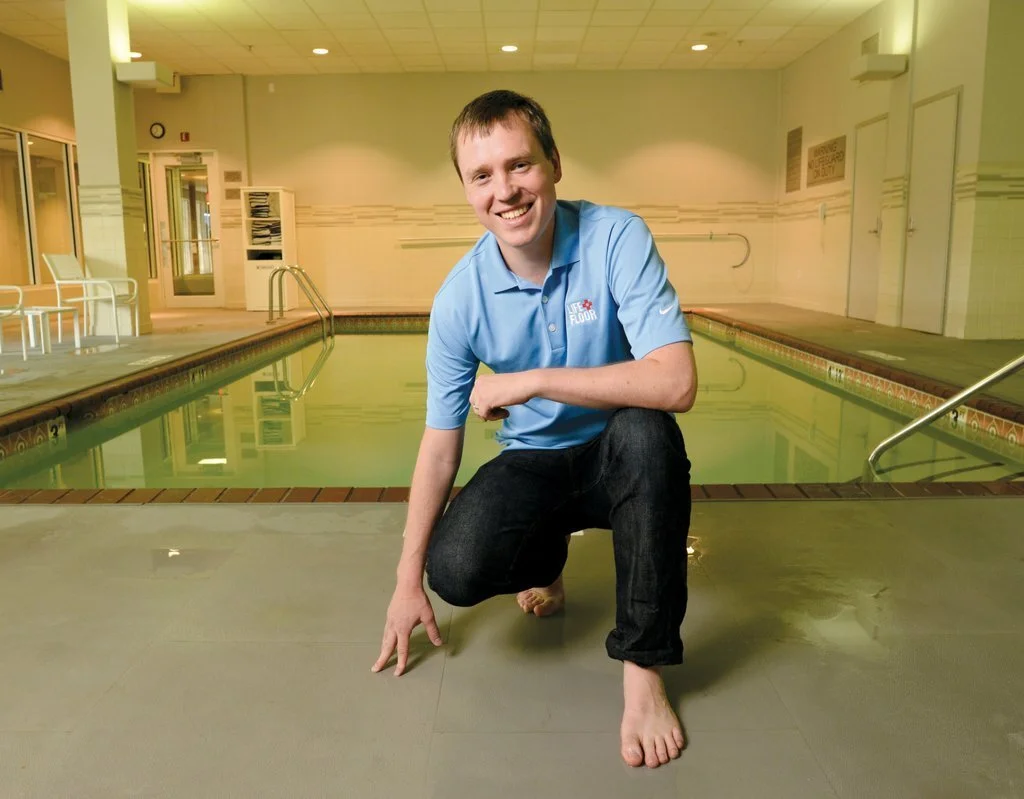
I started Life Floor at 24 with a lot of confidence and a lot of naïveté about what running a business actually required. I have learned plenty of expensive lessons along the way. But I also believe this is what God called me to do, and my responsibility has been to remain faithful to that calling and continue moving forward.
I hope that Life Floor lasts beyond me, but even more importantly, that the industry itself remains changed. I want safer, more beautiful aquatic environments to become the expectation for everyone. If that happens, the work will have mattered regardless of what the company looks like decades from now.
Mentors Who Helped Shape Life Floor's CEO
Who are some of the mentors who have influenced you most?
I've been fortunate to have quite a few mentors, but Tim Welsh and Gus Blanchard were two of the biggest influences in my life and were also two of the largest investors in Life Floor.

Gus Blanchard and Jonathan Keller
Gus was a mentor from basically the time I graduated high school until he passed away in March 2025. He had a lot of sayings that stuck with me, including, "Never tell a customer no; just tell them how much." There is a valuable business lesson in that. A lot of things are possible if you're willing and able to do them, but you have to understand what it actually takes and make sure you're charging appropriately for the work.
Tim has been a mentor since the end of college, when I was an intern, and he was a senior partner at McKinsey & Company. When I started Life Floor at 24, I was living and dying based on what happened from month to month or quarter to quarter. When you are young and starting a company, a quarter feels like a huge amount of time.

Tim Welsh and Jonathan Keller at the Marvelous Mentors Awards, Twin Cities Business, 2016
Tim challenged me to look at progress differently. He told me that as he got older, he had learned to think more in decades. If you're trying to change an industry or fundamentally alter the way people think about something, meaningful change may take a very long time. You have to be able to see beyond one difficult quarter or even one difficult year.
That perspective has been incredibly valuable throughout Life Floor's history. People often overestimate what they can accomplish in the short term and vastly underestimate what they can accomplish over the long term. For us, the question has always been whether we are continuing to move toward the larger goal. We want Life Floor to be the industry standard. We want to be the market leader and the best producer of aquatic safety surfacing. There have been setbacks along the way, but if we are still moving toward that long-term vision, then we are making progress. Fifteen years later, that lesson feels especially meaningful.
Building Life Floor Through People
How has your approach to leadership changed as Life Floor has grown?

Jason Bahrke, Jonathan Keller, Sean Rubin + Spencer Howell
Reunion dinner with the Life Floor founders in 2025 at the same location where the original paperwork was signed to start Life Floor in 2011.
One of the biggest lessons I've learned is that when you build a team of excellent people, your goal shouldn't be to prove that you can do everyone's job better than they can. Ideally, you want to hire people who can do their particular job far better than you ever could.
Then you have to empower them to do it. You hire talented people, give them direction and a clear vision, and create the space for them to use their expertise. You're going to get much better results than if you try to control or personally handle everything.
That has required a significant evolution for me because, in the beginning, I actually did have to do nearly everything. If a floor wasn't clean and we needed good photos the next morning, I was the person cleaning it at midnight. If we needed to install a floor and didn't have the money to hire somebody, we installed it ourselves. When you start a company from scratch, there are periods where everyone does whatever needs to be done.
As the company grows, that has to change. The number of things a leader should personally be responsible for becomes smaller and smaller. You have to become more disciplined about identifying the areas where you can add the most value, while hiring specialists who can take ownership of everything else.
That shift, from doing everything yourself to building and empowering a team, is a major part of the journey of entrepreneurship.

Life Floor team retreat visiting an installation at Baha Bay, January 2023.
Why the Aquatics Industry Still Inspires Jonathan Keller
After 15 years, what keeps you excited about working in the aquatics industry?
One of the things I didn't expect when I started Life Floor was how much the people in the aquatics industry would eventually mean to me. There are so many people in this field who are very clearly not here because they expect to become wealthy or famous. They stay because they know their work matters.

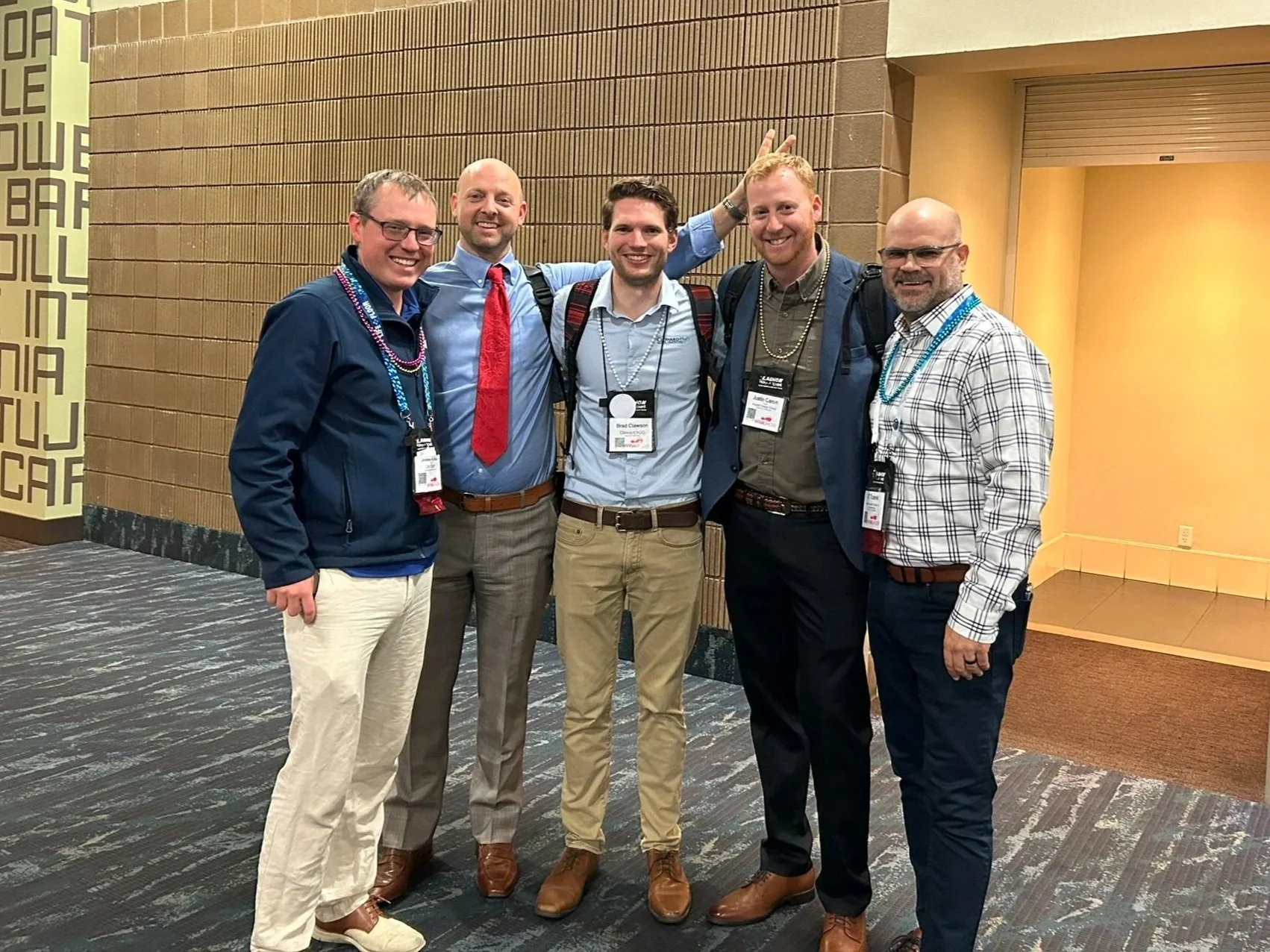
Kyle Seeman, Dan Wade, Jonathan Keller, and Brian Howell at IAAPA 2016.
They are keeping people safe, creating places where families make memories, helping people stay active, teaching important skills, and creating experiences that bring people together. You see people who begin as lifeguards and then become lifeguard managers, aquatic supervisors, general managers, vice presidents, consultants, designers, and industry leaders. Many of them remain in aquatics because they genuinely care about the work and the people they serve.
What I think is especially cool is that aquatics has created its own kind of community. It includes people from all over the world, with very different backgrounds and experiences. Still, there is often a shared set of principles around safety, fun, recreation, health, and creating meaningful experiences for other people.
That can look like helping a senior move safely around a pool deck, giving a kid the freedom to run and play on a splash pad, helping a swim team compete, making an aquatic facility easier to operate safely, or simply giving families a place to spend time together. There are so many different ways people in this industry contribute to making someone else's experience better.
Those are the kinds of people I gravitate toward, people who want to make a difference and who are trying their best to make things better for everyone around them. That sense of shared purpose is one of the things that keeps me excited about being here.
When I started Life Floor, I didn't anticipate that the aquatic industry itself would become such an important part of the story. Fifteen years later, the people are one of the biggest reasons I could easily see myself being part of this industry for another 15 years.





Celebrating 15 Years of Life Floor and Looking Toward What Comes Next
Fifteen years after Life Floor began, the company looks very different from the startup Jonathan helped launch at 24 years old. The team has grown, the product has evolved, the company's reach has expanded around the world, and the conversation surrounding aquatic safety surfacing has advanced significantly. Yet many of the ideas that motivated Jonathan at the beginning remain remarkably unchanged.
At its core, his story and Life Floor's are rooted in the belief that something can be better and that meaningful improvement is worth pursuing even when progress takes longer than expected. It is a philosophy built around discipline, stewardship, strong relationships, talented people, and the willingness to remain committed to a long-term vision.
As Life Floor celebrates its 15th anniversary, Jonathan is not simply looking back at what has been accomplished. He is still looking toward what is possible: safer aquatic environments, more opportunities for meaningful play, stronger communities, and an industry filled with people who care deeply about making a difference. Fifteen years in, that original sense of purpose remains very much alive.
